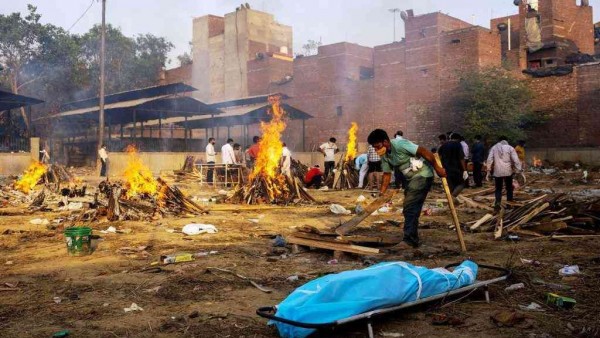
 Covid disaster.
 The Modi government had a year to prepare for the second Covid wave. Yet in 2021, it became complacent, dismantling temporary COVID-19 isolation centers, easing social distancing and lockdown measures, despite warning signs of a next wave and new variants in other countries. India has always had a gap in capacity vs need in its healthcare system. Modi and his band seemed confident that Hinduism, temples and brazen defiance would eventually "kick" the virus out of the country. In fact, on March 20, Prime Minister Narendra Modi, addressed the nation and urged people to stay home to prevent another lockdown. But he failed to share any plans on how the government was going to tackle the second wave.
With the raging second wave of the Covid-19 pandemic wreaking havoc in India, the chief of the World Health Organization (WHO), Tedros Adhanom Ghebreyesus, said on Friday that he is very concerned about the fast-growing caseloads in the country.
“The situation in India is a devastating reminder of what the virus can do,” Ghebreyesus said during a virtual briefing in Geneva.
The situation in the country seems to be slipping out of hands with each passing day, amid acute shortage of oxygen beds and key emergency drugs like Remdesivir.
India reported yet another grim milestone of highest number of daily new Covid-19 cases on Friday. A total of 3,32,730 Covid cases were recorded in the last 24 hours.
The country also registered over 2,000 daily deaths for the third consecutive day with the highest spike in single-day deaths at 2,263 on Friday, taking the cumulative death toll in India to 1,86,920 so far.
On Thursday, India had reported 3,14,835 Covid-19 new cases and 2,104 deaths.
Delhi recorded its highest ever fatalities at 306 on Thursday, besides logging more than 26,000 new cases.
Since April 15, India has continued to report over 2 lakh new Covid cases on a daily basis.
The emergence of particularly infectious variants, a rise in unrestricted social interactions, and low vaccine coverage could be an unfortunate confluence of factors behind the unprecedented surge of coronavirus cases seen in India, according to a report.
“Untangling the causes could be helpful to governments trying to suppress or prevent similar surges around the world,” Nature reported.
After nearly 100,000 daily infections last September, the cases began to drop only to rise again in March this year. The current peak seems to be more than double the previous one.
In December and January, various studies were conducted to test SARS-CoV-2 antibodies — an indicator of past infection. The findings had suggested that more than 50 per cent people in cities such as Delhi and Chennai had already been infected. This led to the notion the worst of the pandemic was over in the country and the next wave could probably be less severe, the report said.
“The studies also suggested that, nationally, some 271 million people had been infected — about one-fifth of India’s population of 1.4 billion,” Manoj Murhekar, an epidemiologist at the National Institute of Epidemiology in Chennai, who led the work, was quoted as saying.
“One explanation might be that the first wave primarily hit the urban poor. Antibody studies might not have been representative of the entire population and potentially overestimated exposure in other groups,” according to Ramanan Laxminarayan, an epidemiologist in Princeton University, New Jersey.
Now the virus could be infecting people, including the wealthier urban communities, who people isolated during the first wave but had started mingling by the second, the report said.
But some researchers attribute the second wave to the emergence of new and more infectious variants — the UK variant (B117) and the double mutation variant (B1617). The current wave is engulfing the entire household unlike the first wave of Covid-19, where only one member was infected, it noted.
Other researchers argue that new variants account for only a small part of the latest spike in daily infections, but people let their guards down due to the pandemic fatigue and the news of vaccines are the major reason.
With cases declining after last September’s peak, “there was a public narrative that India had conquered Covid-19”, Laxminarayan said.
A large gathering of crowds indoors and outdoors for political rallies, religious celebrations and weddings have all added to the surge.
Moreover, vaccinations also need to be ramped up. While more than 120 million doses have been administered, it is still less than 10 per cent of the country’s population, the report said. (IANS)