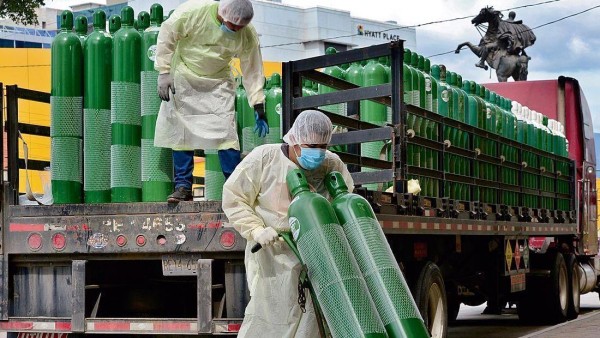
 Acute oxygen shortage.
 Over the past week, many breathless Covid-19 patients have died due to the unavailability of medical oxygen in hospitals across some states in the country. Contrary to claims, the shortage of oxygen in some states is not due to lower production or FY21 exports. As India touches 16 lakh active Covid-19 infections, a number of states have reported shortages of medical oxygen for a growing pool of patients in need of oxygen support. India plans to import 50,000 metric tonnes of medical oxygen to cater to the rising demand. The Ministry of Health and Family Welfare has been directed to float a tender for the import.
India is deliberating on importing oxygen containers and equipment from friendly foreign nations to address the oxygen crisis faced by the country in the middle of the raging second wave of the Covid-19 pandemic.
The Central government is also planning to press the Indian Air Force (IAF) into airlifting oxygen containers and equipment from other nations.
“The deliberations are still on,” said a source, adding that the places from where these containers and other equipment could be airlifted have been identified.
The source said that the problem India is facing in importing oxygen is transportation due to an acute shortage of containers to carry the life saving gas. The government is in talks with all the stakeholders in this matter.
With the second wave of Covid-19 hitting India hard, the Centre has roped in the Indian Air Force to airlift oxygen cylinders, regulators, and essential medicines as the National Capital Region faces shortage of oxygen cylinders and medicines.
The IAF has started airlifting personnel, doctors and nursing staff to help the government battle the pandemic.
Sources said that the IAF has airlifted doctors and nursing staff from Kochi, Mumbai, Vizag and Bengaluru for setting up of a Defence Research and Development Organisation (DRDO) Covid hospital in Delhi.
The force has also airlifted oxygen containers from the DRDO in Bengaluru for the Covid centres in Delhi.
On Tuesday, Defence Minister Rajnath Singh had directed all the defence establishments to set up more Covid-19 hospitals, use emergency powers and bring in retired personnel to tackle the crisis.
A roadmap on how military infrastructure can be used to ramp up the fight against Covid-19 was also discussed in a Covid preparedness review meeting chaired by the minister.
The DRDO had stated that it has set up a Covid hospital in Delhi with 250 beds, and the capacity will be increased to 500 and then to 1,000, if required.
Rajnath Singh had instructed that more fully functional Covid hospitals should be set up in Lucknow, Patna, Varanasi and Ahmedabad within 8-10 days and also at other places where they are required.
He said that the ESIC Hospital, which was converted to a Covid hospital in Patna, has started functioning with 500 beds. He added that work is on at a war footing to set up a 450-bed hospital in Lucknow, a 750-bed hospital in Varanasi and a 900-bed hospital in Ahmedabad.
There were also discussions on roping in retired military doctors and nursing staff for assistance if they are willing to volunteer.
The minister had also suggested to utilise the services of vaccinated retired armed forces personnel to assist the civil administration and state governments to deal with the current situation.
Delhi is gasping for oxygen for a second day running as several hospitals are left with a few hours’ stock.
With the alarming surge in the number of Covid cases in the national capital, if the oxygen quota gets depleted in these hospitals, Delhi will stare at a catastrophe, the Aam Aadmi Party-led Delhi government said in statement on Wednesday.
The statement came after Chief Minister Arvind Kejriwal said that the “Centre has increased Delhi’s oxygen quota”.
“The Centre today (Wednesday) announced that it will supply 480 metric tonnes of oxygen to Delhi, which will take almost 72 hours to reach. The city is running out of time. A total of 140 MT of oxygen, which was supposed to reach Delhi, has not reached the capital so far,” the statement said.
It added that the Delhi government has repeatedly appealed to the Centre to increase its oxygen quota and has also informed it that the suppliers are facing obstructions from district authorities of neighbouring states like Haryana and Uttar Pradesh.
The Delhi government has been demanding oxygen supply from the Centre of up to 700 MT per day. However, it received around 240 MT oxygen on Monday and 365 MT on Tuesday, according to the statement.
Lacking with its own source of oxygen, Delhi’s supply comes mainly from the neighbouring states of Haryana and Uttar Pradesh.
According to the Delhi government, the national capital will get more supply of oxygen from sates like Odisha, West Bengal and Uttarakhand, apart from Haryana and Uttar Pradesh.
“What remains a matter of grave concern is that of the 480 MT, 100 MT oxygen will come from Odisha and West Bengal, which will take almost 72 hours to reach Delhi. Delhi is in dire need of oxygen to save thousands of people battling with the virus. Our citizens, our hospitals, our city is running out of time,” the statement read.
Earlier, Deputy Chief Minister Manish Sisodia, who is also the nodal minister for Covid-19 management in the national capital, had said that the power related to oxygen supply lay with the Central government, which decides which state will get how much oxygen.
“This morning (Wednesday), several Delhi hospitals ran out of oxygen because it was supposed to come from a plant in Faridabad, Haryana. However, a district official reached the plant and stopped the life-saving oxygen vehicles from entering Delhi, claiming instead that going forward, this oxygen will stay with Haryana. When the Centre decides on the issue of oxygen, no state government should have the authority to stop its supply,” Sisodia said.
The state government also shared a list of hospitals facing oxygen shortage:
Indraprastha Apollo Hospital: Currently it has only 10-12 hours of oxygen supply available for all its patients with no other alternative. This level is dangerously low, with supply chain disruptions and delays being regularly witnessed over the week.
Manipal Hospital: Around 230 Covid patients are admitted to the hospital, which has an oxygen backup of merely 12 hours.
Max Hospital, Patparganj: It has around 262 Covid patients and oxygen for about three hours while the oxygen backup for the 285 Covid patients at the Max Shalimar Bagh will last for only about two hours.
Meanwhile, emphasising on judicious use of oxygen, AIIMS Director Randeep Guleria said if a person’s oxygen saturation is 93 per cent to 99 per cent, then that person does not need oxygen, and taking it will instead be harmful.
At a talk organised by the Centre’s citizen engagement platform, MyGovIndia, Guleria said one of the treatments for Covid-19 is oxygen, but it has to be used judiciously. He added that when a person has pneumonia or chronic lung disease when saturation falls, then oxygen is a treatment, given sometimes for a short duration, but sometimes people are on long-term oxygen therapy.
“Important issue here is that taking oxygen intermittently, your saturation is alright, but you say let me take it for half an hour after my meals or if I take oxygen for few hours in the day, my saturation goes up. I am feeling better, and I should continue oxygen, is actually a waste of it. There is no data to show this will be of any help to you,” said Guleria.
“Many patients have started keeping oxygen cylinders at home and taking it 30 min for 2 hour or 3 hours, this is more harmful and again denying people who need it.”
Guleria clarified that those individuals who are having an oxygen saturation of 93-94, there is no need to take high flow oxygen to maintain their saturation at 98 or 99, as it is not going to be of any benefit. He stressed as a country, collectively, if we work together and say we use remdesivir judiciously and use oxygen judiciously, there will no shortage of oxygen in Maharashtra, Delhi, Chhattisgarh or in any other state.
He reiterated that remdesivir is no magic-bullet, and more than 85 per cent recover from Covid without taking this drug. “In a small set of people, remdesivir is required. Does not show any decreases in mortality; it only shows reduced hospital stay… and not a magic bullet,” said Guleria.
Elaborating on the utility of getting vaccinated, Guleria said some people raised questions that what is the point in getting vaccinated, if after two weeks persons turn out to be Covid-19 positive. “Vaccine prevents from getting the disease and not infection. It prevents from infection turning into severe illness and going to ICU…,” he clarified.
Guleria added the antibodies produced by vaccine will not allow the infection to become a severe disease, and emphasised that even after getting vaccinated, it is important to wear a mask. He stressed that people should follow Covid appropriate behaviour, as it is important to bring down the number of cases by breaking the chain of transmission. (IANS)